
The FCC Question: Why Europe's Most Promising Carbon Capture Opportunity Is Still Waiting for the Right Technology.
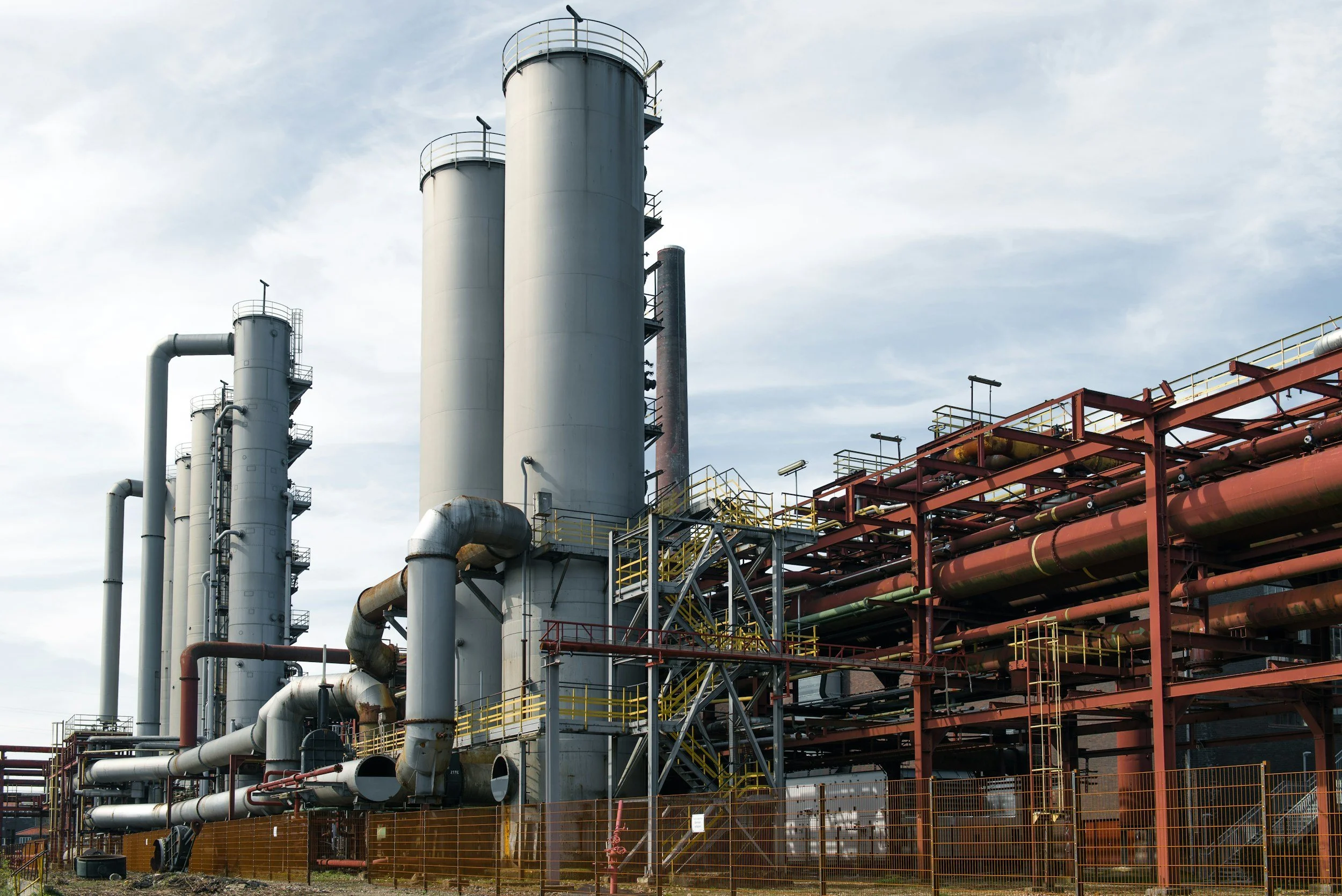
If you ask a refinery decarbonisation team where their hardest remaining emissions sit, the answer comes back quickly: the FCC regenerator. Not because they haven't thought about it — they have, extensively — but because nothing currently available solves it at a cost that works.
The Fluid Catalytic Cracking unit is the workhorse of modern refining. It converts heavy, low-value hydrocarbons into the lighter products — gasoline, diesel components, petrochemical feedstocks — that drive margins. The process deposits carbon (coke) onto the cracking catalyst, which must be continuously burned off in the regenerator to restore catalyst activity and maintain the unit's heat balance. That coke burn produces CO2. A lot of it.
In a typical European refinery, the FCC regenerator accounts for 20 to 35 percent of total site Scope 1 and 2 emissions — making it, in most cases, the single largest point source on the entire complex. A large European FCC unit will produce somewhere between 500,000 and 1.1 million tonnes of CO2 per year from this one process step alone. Across Europe's 15 to 20 major FCC installations, the collective total sits in the range of 8 to 14 million tonnes annually.
These are not numbers that refinery operators are unaware of. Quite the opposite. The major European refiners have invested heavily in decarbonisation programmes — green hydrogen, process electrification, energy efficiency, sustainable aviation fuel production — and several have committed significant capital and engineering resource to tackling the FCC problem specifically. The challenge is that the FCC regenerator occupies an uncomfortable position in the capture technology landscape: too large to ignore, too specific to solve with off-the-shelf approaches.
I've spent the past year working alongside refinery operators, CCS infrastructure developers, and process engineers across Europe on exactly this question. What follows is my attempt to map the landscape honestly: what the operators are doing, what's blocking them, and where I believe the breakthrough will come.
The FCC regenerator: a capture target hiding in plain sight
The FCC regenerator has characteristics that should, in principle, make it an attractive target for carbon capture.
The CO2 concentration in the regenerator flue gas typically sits between 10 and 20 percent by volume — significantly higher than a gas turbine exhaust, though lower than a cement kiln or a pre-combustion hydrogen stream. The gas is produced continuously, 24 hours a day, for three to five years between scheduled turnarounds. The temperature at the regenerator outlet exceeds 700°C, creating substantial opportunities for heat integration with a capture system. And the FCC unit itself is already one of the most heavily instrumented and controlled processes in the refinery, with sophisticated catalyst handling, emissions monitoring, and process optimisation infrastructure.
In other words, this is not an obscure or inaccessible emission source. It is large, concentrated, continuous, and well-characterised. The CO2 is there, it is measurable, and it isn't going anywhere. The question has never been whether FCC emissions should be captured. It is whether they can be captured — at a cost, energy penalty, and operational risk that a refinery can absorb without compromising the economics of the unit itself.
That distinction matters. The FCC unit is not just an emission source; it is the margin engine of the refinery. Any capture solution that imposes too large an energy penalty, disrupts catalyst circulation, or requires extended shutdown for installation is not merely expensive — it is commercially destructive. The operators I speak to understand this better than anyone, and it explains why they have, quite rightly, refused to deploy capture solutions that would solve the emissions problem at the expense of the operational one.
What European operators are actually doing
It is worth pausing to recognise that Europe's major refinery operators are not standing still on FCC decarbonisation. The work being done is substantial, technically sophisticated, and — in several cases — genuinely pioneering. The reason no FCC capture plant exists in Europe today is not a failure of ambition. It is a reflection of how difficult the specific engineering challenge actually is.
The Antwerp cluster: infrastructure meets ambition
The Antwerp-Rotterdam-Amsterdam corridor is arguably the most important refining and petrochemical cluster in Europe, and it is where the FCC capture conversation is most advanced.
TotalEnergies operates Europe's third-largest refinery at Antwerp, with a capacity of 338,000 barrels per day. The company has committed to an ambitious site-wide decarbonisation programme. Its green hydrogen initiative — a tolling agreement for 130 megawatts from a 200-megawatt Air Liquide electrolyser, powered by TotalEnergies' OranjeWind offshore wind project — will reduce site CO2 by up to 150,000 tonnes per year from the end of 2027. Process electrification and a 75 MWh battery storage system are already operational. And the ARCaDe project (Antwerp Refinery Carbon Capture and DeNOx), supported by the EU Innovation Fund, targets approximately 750,000 tonnes per year of CO2 avoidance by 2030.
This is serious, capital-intensive work. And critically, TotalEnergies is one of the few European operators to have addressed the FCC regenerator directly. The ARCaDe project specifically targets FCCU2 — the larger of two FCC units at Antwerp — with the ambition of becoming the first large-scale CO2 capture installation on an FCC unit anywhere. The technology choice is telling: TotalEnergies has not opted for amine-based post-combustion capture. Instead, ARCaDe uses adsorption followed by cryogenic purification — a fundamentally different approach that avoids the energy penalties and solvent degradation challenges that make amine systems unattractive for FCC flue gas. The flue gas pretreatment chain is extensive: selective catalytic reduction for NOx (removing 950 tonnes per year), followed by particulate and SOx removal, before the cleaned gas reaches the capture system. The fact that Europe's most advanced FCC capture project has chosen a non-solvent pathway is, in itself, a significant signal about where the technology is heading.
That said, ARCaDe is one project at one site. The question for the other 15 to 20 FCC units across Europe — each with different flue gas compositions, space constraints, and infrastructure access — remains open.
The CCS transport infrastructure is developing in parallel. Construction began in May 2025 on the Fluxys C-grid Antwerp network — one of Europe's first open-access CO2 pipeline systems, connecting emitters in the Port of Antwerp-Bruges to export and storage terminals. TotalEnergies is a 33 percent partner in Northern Lights, and the ARCaDe project plans to transport captured CO2 by ship or barge to both Northern Lights in Norway and the Aramis storage project in the Netherlands. The infrastructure is arriving — and at Antwerp, uniquely, a capture solution is arriving with it.
Adjacent to TotalEnergies in the same port complex, ExxonMobil operates a refinery of comparable scale. ExxonMobil has taken a different but equally committed approach: the Carbonate Fuel Cell (CFC) pilot at its Rotterdam manufacturing complex, developed in partnership with FuelCell Energy and supported by a €30.5 million Innovation Fund grant. Construction started in mid-2025, with pilot operation targeted for 2026. The technology is genuinely innovative — it captures CO2 from industrial flue gas while simultaneously generating electricity, hydrogen, and heat, making it potentially cost-positive rather than merely cost-reducing. It is also modular, which matters for the space-constrained environments typical of brownfield refineries.
ExxonMobil's willingness to invest in a first-of-its-kind demonstration at its own operational site speaks to a broader truth about the majors: they are actively screening and testing novel capture technologies. They recognise that amine-based post-combustion capture — the default answer for many industrial applications — does not translate well to FCC flue gas. They are looking for something better.
Rotterdam: scale meets strategic reality
BP operates one of Europe's largest refineries at Rotterdam Europoort, with a capacity of around 400,000 barrels per day and an FCC unit that may produce upwards of 900,000 tonnes of CO2 per year — potentially the single largest FCC point source in Europe. The refinery has direct access to the Porthos CO2 transport and storage infrastructure, which connects to depleted gas fields beneath the North Sea.
BP's strategic context has shifted materially over the past 18 months, with the company concentrating investment on fewer, more commercially viable decarbonisation projects. From conversations with people involved in industrial CCS in the Rotterdam cluster, the read is that this strategic discipline actually sharpens the FCC opportunity rather than diminishing it. The projects that survive a tighter investment framework are the ones with the clearest economics: concentrated CO2 sources, proximate infrastructure, and demonstrable cost advantage over alternatives. A large FCC regenerator sitting next to a purpose-built CO2 pipeline fits that description precisely — provided the right capture technology exists to connect them.
The Nordic advantage
Equinor's Mongstad refinery in Norway occupies a position that is unique in Europe. The combined carbon cost on Norwegian petroleum activities — the national CO2 tax plus EU ETS allowances — now exceeds NOK 1,500 per tonne, creating an economic imperative for capture that is unmatched elsewhere on the continent. The Northern Lights storage infrastructure is operational and expanding. Equinor has decades of subsea CO2 storage experience through Sleipner and Snøhvit. If there is a setting in Europe where the economics of FCC capture should work earliest, it is Norway.
In Sweden, Preem has been among the most vocal European refiners on decarbonisation, operating FCC units at both Lysekil and Gothenburg. The completed acquisition by VARO Energy — now trading as VAROPreem since January 2026 — has created Europe's third-largest independent refiner, though the impact on Preem's FCC capture trajectory remains to be seen as the new entity beds in its "twin-engine" strategy across conventional and renewable fuels.
The Mediterranean and beyond
ENI holds a distinctive position in European CCS: the company is simultaneously an FCC operator (at Sannazzaro de' Burgondi, its largest traditional refinery, with an estimated 450,000 tonnes per year of FCC CO2) and the lead developer of the Ravenna CCS hub — repurposing depleted Adriatic gas fields for CO2 storage, with Phase 1 targeting 4 million tonnes per year of injection capacity. ENI has described itself as a "billion-dollar startup" in CCUS. As both emitter and infrastructure developer, it has the shortest possible capture-to-storage pathway of any European refiner.
Further across the Mediterranean and Iberian peninsula, operators including Saras (Sardinia), CEPSA (Spain), Galp (Portugal), OMV (Austria), and MOL Group (Hungary) face a different constraint: distance from storage infrastructure. The economics of FCC capture at these sites depend heavily on the development of cross-border CO2 transport — by shipping, rail, or pipeline — to connect them with North Sea or Adriatic storage. The technology has to work and the logistics have to close.
Why the FCC regenerator has resisted capture so far
The gap between the ambition of Europe's refinery operators and the absence of any operational FCC capture installation is not a contradiction. It is the result of a genuine technology readiness problem — a mismatch between the specific demands of FCC flue gas and the capture technologies currently available at commercial scale.
The amine problem
Amine-based post-combustion capture is the most mature CCS technology, sitting at TRL 7 to 9 depending on the application. It works on power plant exhaust. It works on hydrogen plant tail gas. It has been deployed at meaningful scale in multiple industrial settings.
But on FCC regenerator flue gas, the economics are punishing. The energy penalty for amine absorption ranges from 3.1 to 4.2 GJ per tonne of CO2 captured. For an 800,000 tonne per year FCC unit, this translates to an enormous parasitic energy load — energy that must be supplied continuously, year-round, for the life of the capture plant. Solvent degradation rates are higher with FCC flue gas due to residual particulate matter and SOx content, even after upstream treatment. And the physical footprint of a full amine plant is significant — a real constraint in older refineries where the FCC unit is surrounded by decades of subsequent construction.
From conversations with process engineers at several European refineries, the consistent message is not that amine capture is impossible on FCC units. It is that it is economically unattractive relative to the same investment deployed on other emission sources on the same site — the hydrogen plant, for instance, where CO2 concentrations are higher, flue gas is cleaner, and the energy penalty is lower. When capital is constrained, rational operators address the most cost-effective sources first. The FCC regenerator falls to the bottom of that list — not because it is small, but because the available technology makes it expensive.
The oxy-firing alternative
Honeywell UOP's Synthesized Air FCC approach tackles the problem from the other end: instead of trying to separate CO2 from nitrogen after the fact, it replaces the combustion air in the regenerator with a mixture of oxygen and recycled CO2-rich flue gas. This concentrates the CO2 in the output stream dramatically, making downstream capture simpler, smaller, and cheaper. It also offers operational co-benefits — higher throughput or the ability to process lower-quality feedstock.
On paper, this is compelling. In practice, it requires an Air Separation Unit, fundamentally changes the regenerator operating regime, and introduces new process risks in a unit that runs continuously for years between turnarounds. For operators whose FCC units are deeply integrated into the refinery heat balance and product slate, the operational disruption is a significant barrier — even if the long-term economics are favourable.
Chemical Looping Combustion
CLC replaces the regenerator air with a metal oxide oxygen carrier, delivering oxygen to the coke burn without introducing nitrogen. The result is an almost pure CO2 stream, and the theoretical energy penalty is remarkably low — around 0.21 GJ per tonne, compared to 3+ GJ for amine systems. Academic studies have estimated FCC-CLC capture costs at roughly $10 to $11 per tonne of CO2.
Those numbers would transform the economics of FCC decarbonisation. But CLC for FCC remains at laboratory to early pilot stage. The oxygen carrier materials need to be scaled, proven for long-term durability, and characterised in interaction with real FCC catalyst. This is a technology to watch over a five to ten year horizon — not a near-term solution for operators facing 2030 targets.
The Carbonate Fuel Cell path
ExxonMobil's CFC pilot, as described above, represents one of the most innovative approaches under active development. The technology is electrochemical rather than thermal, generates useful co-products, and is inherently modular. But it is explicitly at the demonstration stage — designed to gather performance and operability data, not to prove commercial readiness. Its applicability to the specific conditions of FCC regenerator flue gas — high temperature, high particulate, significant SOx loading — remains to be confirmed in practice.
The technology gap — and what closes it
The pattern across all of these approaches is consistent: the technologies that are mature enough to deploy today (amine systems) are too expensive for FCC application, and the technologies that could be affordable (CLC, CFC, and others) are not yet mature enough to deploy.
That is the gap. And it is not going to close by waiting for any single technology to reach commercial readiness. It is going to close through site-specific feasibility work — detailed, engineering-led studies that take a particular FCC unit, with its actual operating conditions, flue gas composition, space constraints, turnaround schedule, and proximity to CO2 transport infrastructure, and rigorously evaluate what a capture retrofit looks like in practice. Not generic technology development, but the kind of disciplined, site-level analysis that precedes every major industrial capital decision.
In the interest of transparency: this is exactly the space my own company, Tree Associates, works in. Our approach to FCC capture is based on low-temperature thermodynamic CO2 separation — exploiting the physical thermodynamics of CO2 itself, using temperature, pressure, and phase behaviour, rather than relying on chemical solvents, solid sorbents, or modified combustion chemistry. The energy penalties associated with solvent regeneration or air separation do not apply. We are currently building a demonstrator of the technology for a cement kiln application — a flue gas environment that shares a number of characteristics with the FCC regenerator, though the two are not identical. The underlying science is established; the work now is demonstration engineering, and for FCC specifically, the adaptation of that engineering to the particular conditions of the regenerator. But the thesis is specific and testable: the FCC regenerator's particular combination of moderate CO2 concentration, continuous operation, high thermal output, and existing process control infrastructure creates conditions that may favour thermodynamic capture approaches over the alternatives that have dominated the conversation so far.
The timing argument
There is a reason this matters now, and it is not simply regulatory pressure — though that is real and intensifying.
The CCS transport and storage infrastructure that European FCC operators need is arriving. The Fluxys C-grid in Antwerp is under construction. Porthos in Rotterdam targets 2026 operation. Northern Lights is operational and expanding. The Ravenna CCS hub is in development. The EU's Net-Zero Industry Act mandates 50 million tonnes per year of injection capacity by 2030.
This infrastructure is being built on the assumption that emitters will connect. But for FCC units — the largest single emission source at many of the refineries these pipelines serve — capture solutions are only now beginning to emerge. TotalEnergies' ARCaDe is the furthest advanced, but it is one project at one site. For the remaining European FCC fleet, no capture pathway is yet in place. There is a timing mismatch, and it is closing fast. The infrastructure developers are laying pipe. The EU ETS price makes every unabated tonne more expensive. And the operators who can demonstrate a credible FCC capture pathway earliest will have the strongest position — first in queue for pipeline capacity, first in line for Innovation Fund or national co-funding, and first to prove that their refinery has a viable post-2030 operating model.
The operators who have already invested in site-wide decarbonisation — the green hydrogen projects, the electrification programmes, the energy efficiency gains — have done the responsible, logical work of addressing the emission sources that current technology handles well. The FCC regenerator is what remains. Not because it was neglected, but because it has been waiting for the right technology to arrive.
From conversations with CCS infrastructure developers and refinery decarbonisation teams across Europe, there is a growing recognition that the FCC question can no longer be deferred. The infrastructure is ready, or nearly so. The regulatory trajectory is clear. What is needed now is the specific, site-level engineering work that turns the question "can we capture FCC emissions?" into an investment-grade answer.\
The refining industry has reinvented itself before — leaded to unleaded, high-sulphur to ultra-low-sulphur, simple distillation to deep conversion. Each transition required new technology, new investment, and a willingness to solve problems that looked intractable until someone actually did the engineering. The FCC regenerator is the next one. And based on the quality of thinking I see from the operators and engineers working on it, I am genuinely optimistic about what comes next.
Johan Neethling is CEO of Tree Associates Limited, an industrial decarbonisation company based at Hethel Engineering Centre, Norwich. Tree Associates develops technologies across point-source carbon capture, compressed air energy storage, and refrigeration efficiency, with capabilities spanning thermodynamics, computational chemistry, engineering modelling, and chemical modelling.
This article draws on publicly available data from the EU Innovation Fund, corporate sustainability reports, academic literature, and conversations with refinery operators and CCS infrastructure developers across Europe.
