
Building the Future: Our New Units and What They Mean for the Year Ahead.
This year marks a defining moment for Tree Associates. With a growing team and two major units now in active development, we are moving beyond research and into deployment — bringing our technology to the sectors and regions that need it most.
At Tree Associates, we have always believed that solving the world's hardest energy and emissions challenges demands more than ambition — it demands engineering precision, strategic partnerships, and a willingness to operate in the most demanding environments on earth. In the year ahead, that belief is being put into practice through the construction and expansion of two dedicated technology units: our AirBattery unit and our Carbon Capture unit.
Both units represent years of development work, digital modelling, and real-world validation. Both are now moving into the phase that matters most: real-world deployment. Here is a closer look at each unit, what it does, who it is for, and what we are aiming to achieve.
The AirBattery Unit
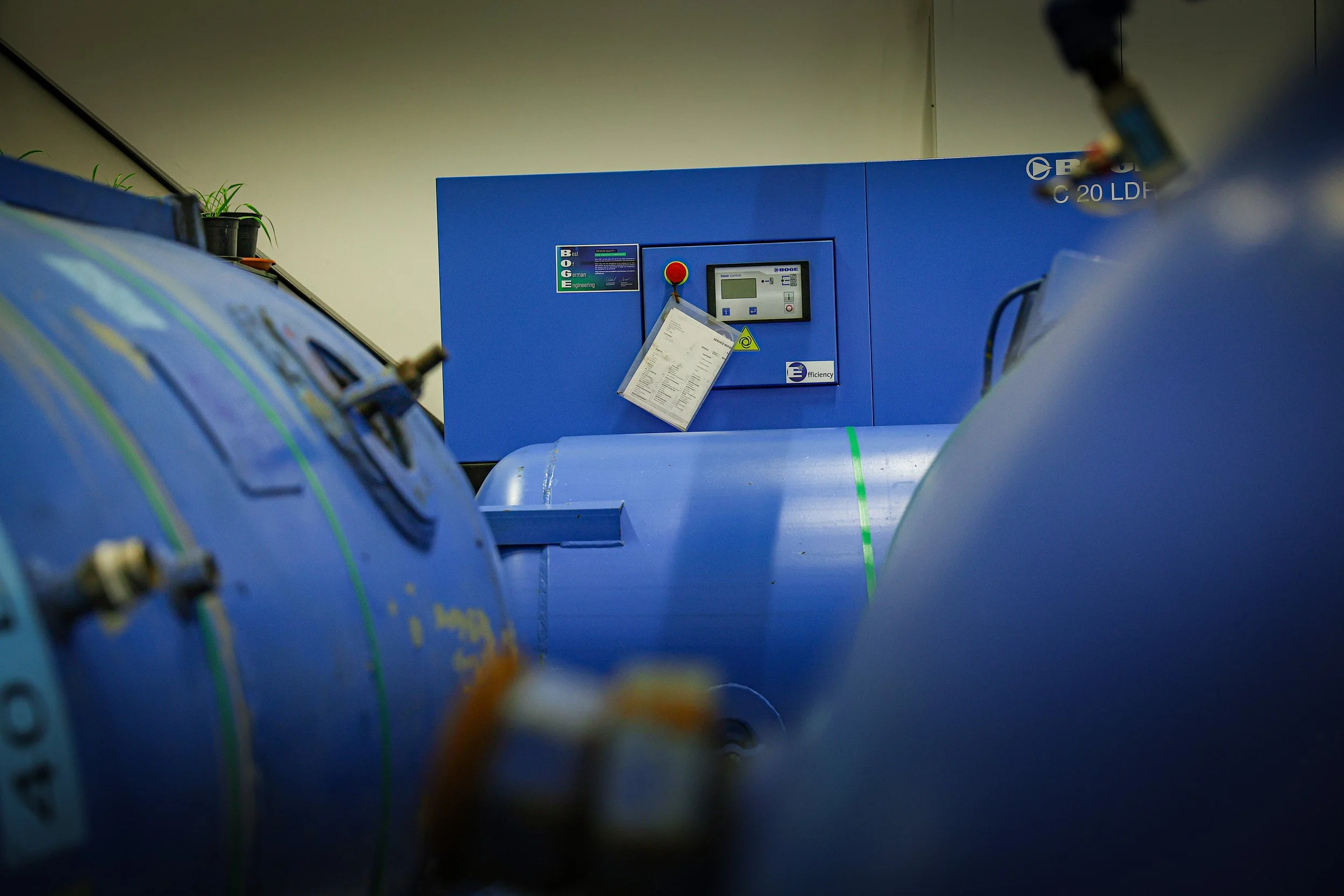
The AirBattery is Tree Associates' proprietary compressed air energy storage system — a clean, chemical-free alternative to diesel generators and conventional battery technology. It works by using surplus energy, whether from renewable sources such as solar and wind or from the grid, to compress air into storage cylinders. When electricity is needed, that compressed air is released to drive a turbine and generate power on demand.
Crucially, the AirBattery contains no lithium, no lead, and no harmful chemicals. It is a zero-emission solution designed to store and deliver energy reliably, wherever and whenever it is needed — including in locations far from any national grid.
Supporting Telecommunication Networks
One of our primary targets for the AirBattery this year is the telecommunications sector — specifically the vast networks of towers that keep mobile connectivity alive across Sub-Saharan Africa. Companies like IHS Towers, one of the largest independent tower operators in the world, rely heavily on diesel generators to keep their infrastructure running in regions where grid access is unreliable or non-existent.
The scale of this challenge is significant. Tens of thousands of telecom towers across Africa run on diesel, generating substantial emissions and incurring enormous ongoing fuel costs. The AirBattery is positioned to change this equation. By integrating our system into tower infrastructure, operators like IHS Towers can replace diesel generators with a clean, renewable-backed energy storage solution — making their networks not only greener, but more economical and operationally resilient over the long term.
This is energy storage designed for the real world: modular, scalable, and able to function effectively in challenging climates and remote locations.
Why Nigeria
Nigeria is our primary deployment focus for the AirBattery this year. As a country where over 70% of businesses depend on diesel generators to compensate for an unreliable national grid, the economic, environmental, and health costs are severe. Diesel exhaust contributes to widespread air pollution, greenhouse gas emissions, and serious respiratory health risks — while the cost of fuel continuously drains resources from communities, businesses, and healthcare facilities alike.
Supported by Zero Emission Generators (ZE-Gen) — a programme co-funded by the IKEA Foundation and UK aid through the UK Government's Ayrton Fund, and led by the Carbon Trust and Innovate UK — Tree Associates has been selected as one of 20 projects to receive funding under the ZE-Gen Technology Accelerator. Our mission is to demonstrate that the AirBattery can replace diesel generators at scale, starting with telecommunications infrastructure and expanding outward from there.
What We Are Aiming to Achieve
Our goal for the AirBattery unit this year is clear: to demonstrate, at real scale, that compressed air energy storage can effectively replace diesel across telecom tower networks — making those networks genuinely green. We will be identifying deployment sites, building in-country partnerships with operators and stakeholders, and progressing through the ZE-Gen Technology Accelerator with a view to scaling rapidly thereafter.
The AirBattery offers a compelling set of advantages for every site it enters. It produces zero direct emissions, requires no harmful minerals like lithium or lead, integrates directly with existing tower infrastructure, and delivers significantly lower operational and maintenance costs compared to diesel — creating long-term savings at every deployment. Its modular design means it can be sized to meet the needs of a single tower or an entire regional network.
If the AirBattery can prove itself within Nigeria's telecoms infrastructure, the implications reach far beyond Nigeria alone. Every diesel generator running a tower anywhere in the world becomes a potential replacement opportunity.
The Carbon Capture Unit
Some industries can decarbonise by switching to cleaner energy or redesigning their processes. Cement is not one of them. Every tonne of clinker — the key ingredient in cement — releases approximately 0.717 tonnes of CO₂ during production, not from burning fuel, but from the chemistry of limestone calcination itself. These so-called process emissions are fundamentally unavoidable by conventional means.
For decades, this has made cement one of the hardest industrial sectors to decarbonise. Existing carbon capture solutions — primarily amine-based systems — have offered a partial answer, but at a steep cost. They are energy-intensive, water-hungry, vulnerable to kiln contaminants like NOx and SOx, and deliver CO₂ in gaseous form that requires expensive secondary liquefaction. The barriers to adoption have been high.
Tree set out to rethink the fundamental principles of carbon capture for heavy industry.
A New Generation of Carbon Capture
Our Carbon Capture unit is built around Tree Associates' next-generation CCS technology — a system engineered from the ground up to outperform first-generation approaches across every meaningful dimension. Drawing on advanced thermodynamic engineering and proprietary expander technology, it reduces energy demand by more than 40% compared to conventional amine systems — before the additional energy cost of compression and liquefaction is even considered. When it is, the comparison becomes stark.
The system maintains a 95% capture rate even under the demanding conditions of active cement kilns. Unlike amine-based systems, it is unaffected by standard kiln contaminants such as NOx and SOx, removing the need for expensive pre-treatment entirely. And rather than delivering CO₂ as a gas requiring further processing, our technology captures it directly as a high-purity liquid at up to 99.81% purity — eliminating an entire layer of equipment and cost.
The result is a system that is simpler, cleaner, more economical, and better suited to the realities of industrial operation.
Who It Is For
Our Carbon Capture unit is designed specifically for cement and clinker producers — one of the most emissions-intensive sectors in the world. Our technology offers these producers a credible, economically viable pathway to meaningful emissions reduction: measurable, verifiable reductions that replace the need for continual carbon credit purchases and directly support compliance with emerging global regulations, including the EU's Carbon Border Adjustment Mechanism (CBAM).
For producers looking ahead, the ability to demonstrate quantifiable, auditable emissions cuts will become increasingly essential to market access and long-term competitiveness. Our system is built precisely for that requirement — delivering CO₂ output that is not only cleaner, but traceable.
The Pilot: Ukraine and IFCEM
Our first major deployment is taking shape in Ukraine, in close partnership with IFCEM, one of the country's leading cement producers. The decision to launch our pilot in Ukraine is both practical and deeply meaningful. As the country prepares for post-war reconstruction, cement and clinker production will play a central role in rebuilding homes, infrastructure, and public services. Ensuring that this reconstruction can proceed with significantly reduced emissions — and in alignment with European regulatory standards — is essential.
The pilot has been validated through an extensive digital twin model built on real-world emissions data from active clinker kilns. This modelling confirmed the technology's performance, resilience, and readiness for industrial deployment. Construction and commissioning of the physical pilot is now underway, supported by Innovate Ukraine, the FCDO, and UK International Development — backing that reflects confidence in both the technology and its broader significance.
If the system can succeed in Ukraine, it can succeed anywhere.
What We Are Aiming to Achieve
Beyond the Ukrainian pilot, our ambition is to establish a replicable, global template for carbon capture in heavy industry. The cement sector alone accounts for some of the world's largest unavoidable industrial emissions. Our technology is designed to offer producers everywhere — regardless of geography or operational context — a practical, scalable, and economically sound route to meaningful decarbonisation.
This year, as we move from modelling to construction to commissioning, the Carbon Capture unit will demonstrate something the industry has long been waiting for: that deep decarbonisation in cement is not a distant aspiration, but an achievable reality.
A Year of Real Progress
Two units. Two industries. One clear direction. At Tree Associates, we are building the technology that the world needs — and this year, we are proving it works. Whether replacing diesel generators powering Africa's telecommunications networks, or capturing unavoidable CO₂ from Ukraine's cement kilns, our mission remains the same: to close the gap between what is needed and what is possible.
We are proud of the growing team making this happen — and we are excited for everything that lies ahead.
